Mon Jan 05, 2009 Category: News Roundup Posted by: Patrick St John
Various Marxist parties have articles and interviews up on the New School occupation. The Stalinist Freedom Road Socialist Organization has an interview with Eric Eingold, and an article up in the Workers World Party's newspaper by SDSer Tyneisha Bowens discusses the role the Unite HERE local played in supporting the occupation.

Probably most interesting - and useful - is MediaChannel's overview of the occupiers' use of media:
But they can also claim a key victory in a less obvious battle—the battle over message. For two and a half days students reported from inside the cafeteria using text messages, email, blog posts, Youtube videos, and Twitter feeds. They responded to New York Times' City Room blog posts with news updates and fact checks. They countered Kerrey's labeling of the occupation as a "security risk" by posting videos of security personnel using excessive force on occupiers. They made their demands and their decisions clear and free for all to read. It was all in real time—and it was all powered by the university's electricity and wireless Internet.

Emailing out press releases and updating twitter feeds are certainly less interesting to read about than blockading doors and confronting cops, but if we are to learn the lessons of the New School occupation that's exactly what we should read.
Tue Dec 23, 2008 Category: General Posted by: Patrick St John
The awesome folks who put on the Rethinking the University conference are at it again! Mark your calendars, to either attend or contribute to what should be a very important gathering.
---
Reworking the University: Visions, Strategies, Demands
April 24-26, 2009, University of Minnesota

Call for Ideas - Please Distribute Widely!

The current “financial meltdown” has exacerbated the ongoing crises within the university, resulting in even greater budget cuts, tuition hikes, hiring freezes and layoffs. Responses from university administrations have been predominantly reactive and have served to fortify the university as an institution of neoliberal capitalism. The administration and others have narrated this crisis as an external force that, while dramatic in the short run, can nonetheless be managed properly. It is clear to many, however, that the neoliberal logic that has been used to transform the university over the past few decades has failed at a systemic level; the neoliberal death spiral has come home to the university.

In contrast to these reactionary responses, we seek to create a space for collective re-evaluation of the university in crisis as an opportunity for real transformation. Last year’s conference, “Rethinking the University: Labor, Knowledge, Value” (April 2008), sought to challenge the supposed inevitability of the neoliberal university. As a continuation of this project, “Reworking the University” seeks to draw together academics, artists, and activists, to share and produce political visions, strategies and demands for building an alternative university in common.

“Reworking the University” seeks to generate a vibrant, political exchange by troubling the traditional format of the academic conference. To this end, we hope to produce spaces for individuals and groups from different backgrounds and across a variety of institutional boundaries to converge. While the conference will include the presentation of papers on the topic of “Reworking the University,” the committee’s selection process will prioritize workshops, roundtables, trainings, art installations, film screenings, performances, and other forms of creative engagement.

The conference organizing collective has selected several questions and themes that emerged out of the 2008 conference that we will address in various formats. If you have interest in participating, please provide us with a description of your proposed contribution. We encourage you to self-organize a session (i.e. a performance, workshop, roundtable, training, etc.) and submit it as a whole. Feel free to use the blog (http://rethinkingtheu.wordpress.com) to help facilitate session organizing.

Below is a list of possible topics and we, of course, welcome additional suggestions. In submitting your ideas for sessions, please give us as much information as possible—suggestions for themes, other participants and the session format.

The Reworking the University conference coincides with “Reclaim Your Education – Global Week of Action 2009” (April 20-27: http://www.emancipating-education-for-all.org/). Organizers also encourage suggestions for additional actions as part of this event.

Send your submissions (of up to 500 words) to comradmn@gmail.com. The deadline for submissions is February 10, 2009.

- Confronting American Apartheid: Access to education
- The financial crisis and the university
- Counter/Radical Cartographies and Disorientation Guides
- Corporate funding and the university
- Autonomous/Open/Free Universities
- The Poverty of Student Life
- Post-Enlightenment Visions: Beyond the Liberal Model
- Anarchism and Education
- Adjunct Unionization
- Organizing Across Campuses, Cities, and Regions
- Post-Antioch Universities/the Antioch Legacy
- Anti-militarization Movements in the University
- Prisons and Education
- Undergrad Education Beyond Commodification
- Historical Struggles in the University: May ’68 and beyond
- Autoreduction and Tactics for Direct Action in the Workplace
- Contemporary Struggles in the University: The Anomalous Wave & Movements in Italy, Greece and elsewhere
- Expropriating Institutional Space
- Graduate student unionization and Radicalizing the Academy
- Anti-professionalization; Anti-disciplinarity
- Student Debt
- Pedagogy of the crisis
- Creating Radical/Open Access Publications and the Politics of Citation

The schedule and proceedings from last year’s conference can be found at:
http://www.makeumnpublic.org/conference.htm

Sincerely,

Committee on Revolutionizing the Academy (ComRAD)
comradmn@gmail.com
Sun Dec 21, 2008 Category: Student Unionism Posted by: Patrick St John
—The New York Times has a few decent articles on the New School Occupation and the larger context of everyone hating Bob Kerrey, but probably the most useful writing on the occupation was written by one of the occupiers.

With blazing speed, Tim Hearin, a New School grad student, penned an analysis of what happened over the past several days, with an eye for lessons we all can learn from the occupation. I'm reprinting it here, but it's also available at Indymedia and elsewhere. If others are posting analysis pieces, link to them in the comments.


Rules of Thumb Learned by An Occupant of the New School in Exile
As the dust settles, here are some reflections on useful strategy and tactics.
by Tim Hearin

The New School Occupation banner - courtesy newschoolinexile.comSome of these rules of thumb can be generalized, and perhaps others cannot; nevertheless, they comment on the specific context of the student occupation that lasted two days and won important concessions from the New School, including amnesty. The students agreed to continue the struggle next semester. This is only the beginning...

For brevity, I’m not going to give the background of the occupation. Two great sites to learn about it: http://newschoolinexile.com and http://newschoolinexileblog.blogspot.com

Besides a 20 or so core of extremely devoted students, the demographics (and actual numbers) were in constant flux. Excuse the labels, but broadly, if there were 100 students at a given moment, roughly 25 were Anarchists or revolutionaries of some sort committed to serious (sometimes spontaneous) direct action to achieve our goals. 40 were members of the Radical Student Union (formerly Students for a more Democratic Society), were loosely affiliated with them, or whose politics generally fell in line with their pro-negotiation, “Just reason it out with the authorities” attitude. This is not to say that Anarchists spurned negotiations—I did not. Or that RSU members scorned the many direct actions in the occupation—though, I must write here, from the beginning, many prominent members were against the occupation, then against staying after the first night, then against taking control of the entrance/exit, then against our spectacular midnight ruse in the last few hours of the occupation that not only linked the wild supportive demonstration outside with us inside, but also breathed vastly new energy and power into our occupation, calling many of these successful and bold moves, among other things, “Custeristic”. In fact I successfully defended a makeshift barricade with the fierce help of two fellow occupants who were RSU members. I am proud to call them comrades. The lines are somewhat blurred.
Finally, 35 were left liberals who were explicitly against direct action, even though, ironically, the entire occupation was predicated on direct action. Most joined after the initial occupation, probably believing our occupied space was “just a study space,” or that “the authorities were permitting us to be there,” as opposed to knowing it was us who made it so. To my knowledge, none in this group was among the 20 or so core of students mentioned above. I am critical of the latter two groups, but believe me when I write that even being there was a feat in itself, and I am sincerely thrilled they were bold enough to join.
These rules are by no means definitive. While I myself am an Anarchist who was pushing for more direct actions to expand our space, insofar as we were numerically and strategically capable, I encourage healthy debate and criticism of my conclusions.

1. Limited negotiation is fine in terms of winning explicit concessions, but in order to have negotiations, you must have bargaining power, and this requires bold direct action. This belief, this mode of resistance, was the reason for our success. Despite the political inclinations of many of our well-intentioned and intelligent comrades in the New School in Exile (and despite their ever-present reluctance), it was the taking of the cafeteria, the blocking of the doors, the control of the building, that was our power. Of course, our aforementioned “political” comrades celebrated each and every direct action vigorously after the fact, realizing the terms of negotiation had just been changed in our favor, despite their initial resistance to it, saying things like “it’s too disorganized; it’s too brazen; it’s too illegal”—it’s too this or that. Even our last action, when we linked the wonderful movement outside to us inside by the opening of a fire door at midnight, changed the status of the ongoing negotiations in our favor. This was said before us by one of our own negotiators, who herself was not necessarily pro-direct action.
It goes without saying that negotiations are meaningless if you’re bold enough to topple those who would negotiate with you, and this end goal should always be kept in mind for those who want a radically better world. The ultimate power of authorities cannot be abolished through negotiation.
Forgive the platitude, but you must dare to win. Confident but collected, brazen but not reckless, direct action is a primary weapon of revolt. Do not wait for the authorities to give you permission. At the outset, we did not wait for their permission, and that impatience was the engine of our progress. Before that, we were stalled. Remember: the reason why we resorted to an increasingly provocative and popular occupation was because the words, the negotiations, of faculty were meaningless. Their vote of no confidence was mocked by Bob Kerrey’s comments to the New York Times that the only votes he cared about were those of his trustees. The students were not even allowed into meetings concerning the No Confidence vote. We were only taken seriously when we dared. We were only taken seriously when we barricaded the cafeteria, when we controlled the entrance/exit, when we repeatedly disrupted operations in 65 5th avenue and elsewhere, contrary to the orders of police, of New School authorities. For that, we won important concessions and further destroyed the reputation of Bob Kerrey.
For that, we continued the inspiring example of the workers in Chicago and the anarchists throughout Greece.

2. While democratic consensus should be the watchword of a revolutionary situation—it was a crucial facet of our decision-making inside the cafeteria—direct action should not always wait for mass confirmation before being initiated. In our case, deliberation often took hours when there was an immediate concern at hand; and there was the problem of the newer, more liberal elements who did not have a clear-eyed conception of the occupation. Any further direct action would have been blocked.
On several occasions, a few of us had to bolster or defend a barricade without popular consensus. When we took the entrance/exit, we did not wait for popular consensus. Our spectacular midnight ruse did not wait for popular consensus—in fact, in a vote it was shot down.
This is philosophically problematic, I realize, and I am troubled by it. All I can say is that moves should be made to ensure that the consequences of a direct action should minimally affect those comrades who do not support it, and should never put them in harm’s way. Now, if your enemy does not support it, that probably means you’re on the right track.

3. The physical barricades—desks, tables, dumpsters, planks of wood, etc.-are merely one of two primary components of successful defense, and perhaps the weaker of the two. The physical barricades saved us multiple times. This is fact. However, when the NYPD were committed to smashing our barricades, they did so, and quickly, like when they physically extricated us from our barricaded fire exit. The second component is outside support and solidarity that is won through dissemination of your cause and actions. The media we received garnered wide popular support from liberal faculty members in other American schools to students in Mexico to Greek anarchists who did direct actions in shows of solidarity with us. It would have been even more of a public relations disaster if the NYPD mass-arrested 150 students. Outside support was too strong; the sympathetic public eye was focused on us! In fact, for many hours our front door was not barricaded physically because we knew we were too connected to vigorous outside support to be raided. I should note here that, in addition to the direct focus of your cause, it’s also critical to expand your solidarity, connect the dots, between you and other movements.
Most apparently, an important reason why the NYPD did not storm our fortified cafeteria on the last night is because of the massive demonstration outside. (A banal meta-reflection, the cameras and journalists who were inside with us filming and reporting put an immediate stop to police brutality when the cops realized they were being recorded).

4. Security guards are not on your side. We can argue for days about whether they are fellow workers—which is an irrelevant argument anyway—but despite your friendship with a security guard, or the guard not being happy with his union contract, or the guard claiming he is on your side, he is not. Sure you can crack jokes with him and talk about your common music interests, but open your eyes when the moment is not trivial. He will push against the barricades. He will tackle you. He will rip your clothes. He will call the cops on you. That is his job. I think of economic conscripts, GIs in Iraq. Yes, they might bring candy to kids in the street. They might hate President Bush. They might even hate the military-industrial complex. But when there is resistance to their presence, they will be ordered to snuff it out. In order to keep their job, they must obey. This is not to say that soldiers or security can never be on your side, but it would require them doing precisely the opposite of what is required of them.
One more comment on this. There was a security guard during the occupation who was also a student. Some RSU members were friends with him, buddying up with the guy and even inviting him in at points. But what happened on the last night when we propped open a fire door and let in scores of supporters and students? This very same security guard who was “just a fellow worker” was seen tackling students trying to get on the right side of the barricades.

5. Ever-expanding occupation is an extremely effective tactic for revolution.
Fri Dec 19, 2008 Category: Student Unionism Posted by: Patrick St John
Letters of support have been pouring in, most recently one from Todd May of Clemson, and one from student activists at Antioch.

Last night, the occupying students (the Occupation Assembly) listed a set of demands (apart from the larger long-running demands) that they insisted be agreed upon by the administration that night:

  1. Amnesty for all participants in this student movement, including Elliot Liu. Staff and security guards affected by this protest shall receive appropriate compensation and no repercussions for dutiful fulfillment of their jobs;

  2. That students may use the GF building at 65 Fifth Avenue until a suitable replacement is secured, that all capital improvements at the university shall be suspended and these funds shall be redirected toward (a) an autonomous student space where we can study and engage in group work, (b) scholarships and tuition, (c) a respectable library, that students will be included in the decision-making process in order to establish a viable plan for a student space;

  3. That all investments and finances shall be fully disclosed so as to permit complete transparency and intelligibility of the creation of a Socially Responsible Investment committee;

  4. That an equitable and authoritative tripartite committee including faculty, staff, and students to select an interim provost as well as a permanent replacement for provost, and a new president and vice president, for which there will be no presidential veto for this committee's decision;

  5. That there be regularly appointed a student as voting member on board of trustees; and

  6. That President Bob Kerrey, Executive Vice President Jim Murtha, and Treasurer Robert Millard be removed from their present positions at the University.

We ask that these demands are binding, and that they be met in writing, on New School University letterhead, signed by President Kerrey or members of the Board of Trustees, BEFORE we leave this building, and that they be presented to students in the second week of spring semester.
We demand further that:
  1. Demands 1 and 2 be approved immediately in writing;

  2. Demand 3 be enacted in a succinct and clear presentation at a school-wide student assembly during the second week of the spring semester - and that the student body be notified of this next week;

  3. Demand 4 be initiated by next week, and that we be notified of this in writing;

  4. Demand 5 be finalized at the next board meeting; and

  5. Demand 6 be met by the beginning of next school year.

The gambit worked -- Bob Kerrey signed off on most of the demands! You can check the letter he signed below:
Bob Kerrey letter to New School occupying students page 1
Bob Kerrey letter to New School occupying students page 2

With chants of "WE ARE WINNING / IT'S NOT OVER," roughly a hundred occupying students left the cafeteria around 3:30 AM, spilling out onto 5th Avenue into the arms of more supportive students and demonstrators who had gathered. The semester has ended on a high note - the real task ahead is maintaining and building upon the momentum they fought so hard for over this past week. Get some rest, New School students. You've more than earned it.
Thu Dec 18, 2008 Category: Student Unionism Posted by: Patrick St John
Youtube user givehimdanger is posting videos from the occupied building. This one lays out nicely some of the problems students have with Kerrey and his cronies, but check out all his videos!

Thu Dec 18, 2008 Category: Student Unionism Posted by: Patrick St John
12:05 PM - Apparently Bob Kerrey made an appearance a few hours ago, and after he left the NYPD started coming in and attempting to pull out students at random. Things are a bit hectic, so I'm waiting on a call for more information, along with how the press conference went. The occupants' blog:
Mr. Kerrey has retreated into the Swayduck and now the NYPD has begun to indiscriminately grab people and drag them out of the university. They have been using unnecessary force!

12:17 PM - Several students have been arrested; reporters from Democracy Now! and the NYT are on the scene.
1:58 PM - Cafeteria workers, who are unionized, are honoring the picket and refuse to cross the barricades!
4:18 PM - Just got word that there will be a rally tonight at 10 PM in front of the building, on 5th Avenue between 13th and 14th Streets. 10 PM is the usual closing time for the building, so things could get interesting - the students need YOUR help! Bring supplies - food, poster-making supplies, cell phone chargers, etc.
Wed Dec 17, 2008 Category: Student Unionism Posted by: Patrick St John
UPDATE: The students' site, newschoolinexile.com, is up and working! Also, join their Facebook group!
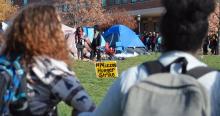
UPDATE 2: There are reports of anywhere between 40 and 60 students occupying the cafeteria; they've been there since 7:00, and apparently have the place pretty well-barricaded. The doors locked at 11:00, and from what I've heard folks are going to spend the night there. The building they're in, the Albert List Academic Center, contains the now-occupied cafeteria, a library, and offices. Currently the only space occupied is the cafeteria (emphasis on "currently"). Interestingly enough, the List building is scheduled for demolition early next year, to be replaced with a shiny brand-new "Signature Building". The souring economy, combined with hostility from neighbors, has dramatically scaled back and delayed those plans.
UPDATE 3: The New York Times has posted an (albeit short) article on the occupation. Media coverage will be key if Kerrey's to get the boot.
UPDATE 4: Looks like there is a rally scheduled outside the building in about an hour - 10:30 am this morning (Thursday). Updates every half hour are promised at newschoolinexileblog.blogspot.com. One of the occupants, Dave Shukla, has penned a note here laying out more of the grievances students have against the current incompetent management.


From Indymedia, and about a million other places:
Wednesday, December 10th, the Radical Student Union issued several demands at a demonstration and sit-in at the Board of Trustees meeting for the New School University. With a student occupation underway in the New School cafeteria, the same demands are being brought to the fore with greater force.
The student occupation is happening as I type this (11:54 pm), and I'll be posting more as I get it. Meanwhile, here's a letter they've sent to the New School community, which relists their demands:
What We Want:
  • The removal of Bob Kerrey as president of our university
  • The removal of James Murtha as executive vice president of our university
  • Students, faculty, and staff elect the president, EVP, and Provost.
  • Students are part of the interim committee to hire a provost.
  • The removal of Robert B. Millard as treasurer of the board of trustees.
  • Intelligible transparency and disclosure of the university budget and investments.
  • The creation of a committee on socially responsible investments as defined in our booklet.
  • The immediate suspension of capital improvement projects like the tearing down of 65 fifth Ave.
  • Instead, money towards the creation of an autonomous student space.
  • Instead, money towards scholarships and reducing tuition.
  • Instead, money for the library and student life generally.


Here's video of New School students (apparently on Wednesday) explaining why they want Kerrey out.

Here is their booklet: "The Project for a Socially Responsible University."
Thu Dec 11, 2008 Category: Student Unionism Posted by: Patrick St John
New School for Social Revolution
Organizers at the New School in New York City recently formed a Radical Student Union there, and all signs point to them really knowing their shit; from what I've read and heard, they're doing all the right things. I got this press release via email:

--------

FOR IMMEDIATE RELEASE

NEW SCHOOL STUDENTS HOLD SIT IN – DEMAND TO ADDRESS BOARD OF TRUSTEES

NEW YORK, NY – At 2pm this afternoon, New School students part of an organization called the Radical Student Union (RSU) along with members of the War Resisters League held a demonstration to demand university investment disclosure, the implementation of a committee on socially responsible investment, and removal of the treasurer of the Board of Trustees, Robert B. Millard. The demonstration started at L-3 Communications headquarters at 600 3rd Avenue and ended at the New School’s Arnhold Hall at 55 W. 13th Street where the Board of Trustees was having their last meeting of the semester. At about 5pm, after the request of the students for five minutes to present their demands to the Board of Trustees was denied, the protest became an impromptu sit-in when about 60 students entered the building and proceeded to fill the lobby demanding their requests be met.

Students were protesting the treasurer of the Board of Trustees, Robert B. Millard, because of his position as chairman of the executive committee of the military contractor L-3 Communications. L-3 Communications provides a large percentage of the “intelligence personnel” employed in illegal detention centers in Iraq, Afghanistan, and Guantanamo Bay, and is currently facing four lawsuits from Iraqis tortured at Abu Ghraib. L-3 subsidiary, Military Professional Resources Incorporated (MPRI) also armed and trained both sides during the Bosnian conflict in the 1990s and armed and trained the Georgian army prior to and during their attack on Russia.

Last semester, the RSU brought these demands to the attention of the university’s president, Bob Kerrey, when they held a demonstration against L-3 and Millard and attempted to attend a Board of Trustees meeting. At the demonstration they were granted a meeting with Kerrey—it was here where they fist brought their research and demands around investment disclosure, Millard, and the Socially Responsible Investment committee (SRI) to the attention of the President. However, Kerrey refused to disclose the university’s investments to them or anyone else and made it perfectly clear that he had no intention of ever letting students know what the university is invested in. He also made it clear that he had no intention of ever letting students sit as voting members of the board of trustees. The Radical Student Union believes this denies students an important right to have a say in their own education. Ironically, Kerrey hosted a conference on "Free Inquiry" and threats to academic freedom in late October while he is clearly the biggest obstacle to the free inquiry of students who care about the future of their university.

The students participating in the sit-in remained patient, relatively quiet and un-confrontational while they waited to see if the Board would grant their requests. Other students brought pizza and coffee to those participating in the sit-in. After about an hour, students realized the Board was not going to meet with them and they pushed into the blocked off area, passed the security guards and attempted to climb the stairs that led to where the Board was meeting. The security guards prevented the students from entering the meeting and the students began to lead chants around investment disclosure and the removal of Millard. The meeting, which was happening directly above where the students were chanting, was forced to move because of the demonstrators. The trustees’ coats and personal items at the coat check next to the students were passed up one by one to a staff member on the stairs. The students moved outside around 6:30pm when they realized a car was waiting at the basement exit of the building—the only alternative exit to the front door. The group disbanded around 7pm after most of the Trustees had left the vicinity. A security guard informed one RSU member that the Board of Trustees meeting, which was scheduled to end at 8pm, ended an hour and a half early, at 6:30pm.

“On the 60th anniversary of the Universal Declaration of Human Rights the university chose to hide itself instead of being accountable and open about its connections to human rights violating corporations like L-3,” said Slim Lopez, RSU member and University Student Senate Representative. “The New School markets itself on being a “progressive” institution with a commitment to social justice—yet its Board of Trustees includes members who are in direct opposition to this mission.”

“The fact that the board of trustees had to sneak out of the freight door entrance instead of talking to the students is very telling of their need to keep students out of the decision making procedures of the university,” said Kate Griffin, another RSU member and University Student Senate representative. “They know they are in the wrong and they know our demands are legitimate.”

“The demonstration today has proven that students in the United States are not passive and apathetic,” said Ronnie Almonte, another RSU member. “The students at the New School will be an example to both public and private universities, city and nationwide, who demand legitimate decision making power in the management of their schools.”

The proposed SRI Committee on Socially Responsible Investing and University Self-Management would allow students, faculty, staff, and alumni to oversee the university trustees’ investment decisions and make sure that the university’s investments are in alignment with the ethical and social values of the New School. The committee would make decisions regarding whether or not an outside corporation meets the ethical criteria required for a contract with the University.

RSU is an education and social action student organization dedicated to restoring democracy in all phases of our common life. It seeks to promote the active participation of young people in the formation of a movement to build a humane and self-managed society free from poverty, ignorance, war, exploitation, racism, sexism, heterosexism, and all forms of oppression.

__

For More Information:
Contact New School RSU via email:
NewSchoolForRevolution@gmail.com
Or visit us on the web:
RadicalStudentUnion.blogspot.com
Mon Dec 08, 2008 Category: International Posted by: Patrick St John
Greek youth and students, already facing budget cuts for youth programs, a repressive conservative government pushing the privatization of the university system, and a slowing economy where their degrees mean less and less, are now apparently fed up. The spark? The police killing of a 15-year-old boy. Reuters:
ATHENS (Reuters) - Greece braced for a third day of demonstrations on Monday after the fatal shooting by police of a teenager triggered underlying anger over the Conservative government's economic policies and the worst rioting in decades.

Thousands clashed with police and rampaged through Athens and other cities this weekend, destroying scores of businesses, injuring dozens and piling pressure on the conservative government, whose ratings have already been hit by a slowdown.

"Athens and Thessaloniki under siege" said daily Eleftheros Typos on its front page, while Apogevmatini newspaper headlined: "48 hours of horror".

Despite the arrest of two police officers for the killing of the 15-year-old boy, the Greek Communist Party announced a mass rally in central Athens for Monday evening and the socialist PASOK opposition, which has taken the lead in opinion polls recently, called for peaceful mass demonstrations.

What a different society Greece has. If only we had seen such outrage after the police killing of Deonte Rawlings in DC.
Mon Dec 08, 2008 Category: International Posted by: Patrick St John
NPR recently aired a program on All Things Considered that looked back, 40 years later, at the massacre of countless students in Mexico City:
The number of civilian casualties reported has ranged between four — in the official count directly after the event — and 3,000. Eyewitnesses recount seeing dozens of bodies and prisoners being trucked away to military bases. But despite efforts by both the student leaders and the special prosecutor to compile the names of the dead, only about 40 have been documented. No siblings, parents or friends of the remaining casualties — if they exist — have come forward to add names to the list.

But new information has come to light through the release of official documents. They reveal that the Presidential Guard — a branch of the military — had posted snipers in the buildings surrounding Tlatelolco Plaza on the day of the massacre. The idea was that the snipers would shoot at the troops posted around the square, and the troops would think student snipers were shooting at them — and then they would open fire. [emphasis mine]
That government forces often act as agents provacateurs is well-known, but it's still slightly surreal when hard evidence of it stares you in the face - especially at an event so crushing and brutal. You can listen to the very emotional program and watch newly-uncovered footage here.

The Mexico City massacre was a bloody, tragic bookend to 1968 - and to the 60s as a whole. Both '68 and its decade were marked with stunning triumphs and demoralizing defeats, and the inspiring flowering and then violent extermination of Mexico's nascent student movement is often stuck in the shadow of "higher profile" events that year.
Sun Nov 30, 2008 Category: General Posted by: Patrick St John
Administrators and Trustees show their true colors

In the face of record budget cuts for universities and colleges across the country -- both public and private -- now is the perfect time for students to assert their influence on important decisions coming down the pike.

Thanks to their insistence that students and faculty have no real say in the budget process, university administrators and trustees have few other places to point the finger of blame (other than to generic woes like the stock market, investor skittishness, state budget shortfalls -- but you'll note they use these excuses just as often during times of surplus too). Idiotic "investments" into massive stadiums and grandiose buildings are permanent, unrecoverable costs. The aspects of higher education that are truly meaningful and important are, unfortunately, all too recoverable: scholarships can be rolled back, professors can be fired, and department budgets can be cut.

Administrators and Trustees are eager to assert responsibility, except when something goes wrong. During times of plenty, the line is "trust us, we're the experts with money, and only we can handle the budget effectively." During times of scarcity and crisis, all of a sudden it's "Don't blame us! We're victims of circumstance and factors outside our control - blame someone else!" If they're so keen on taking responsibility when they're flush with cash, then let's hold them to it when they've mismanaged themselves into the red.

This is an opportunity for students to unite and tell those who run the university "you've had your chance -- it's time for more responsible people (that's us!) to take the reins."

Possible goals:

  • Read up on concepts like participatory budgeting, adapt them for your campus, and present them as alternatives to the current closed-door method of budget-setting.

  • A popularly-elected board of trustees and President, with a majority consisting of students, faculty, and support staff.

  • A binding say in the budgets of departments students are majors in (e.g. Biology majors should have a voice and vote in the budget plans of the Biology department).

  • A campus-wide referendum requirement when tuition hikes are proposed.

  • Open and transparent budget proceedings.


Possible talking points:

  • Emphasize the staggering numbers involved. Huge budget shortfalls, often in the millions even for small schools, are likely compelling enough to rile up the most apathetic of students.

  • Capitalize on the prevalent "throw the bums out" feeling. The trustees and administrators, like the executives on Wall Street, are the ones who got us into this mess. We shouldn't reward them by letting them continue to foul up our education.

  • And let's not forget, many of the business leaders on our Trustee boards literally have their hands in the current economic fiasco -- if there are concrete links, play them up like there's no tomorrow.

  • This is our money, and look what happens when others are put in charge of it! If the university expects us to pick up the tab, then we get to decide what's being ordered.

  • When those in charge screw up, we -- students, faculty, and staff -- are the ones who pay for it. Most students are incensed that the government bailed out these irresponsible financial giants. Remind them that when it comes to the university's finances, we the students are the "government" that administrators expect to bail them out. Are we going to be just like the government and give them our tuition dollars, no strings attached?

  • History has shown that it isn't a matter of appointing "better" Presidents and VPs - it's a matter of wielding power ourselves, collectively and democratically.


Some possible tactics:

  • Fill the op-ed (and hard news) pages of the student newspaper with outrage about the mismanagement of university resources, demands for its change, and models of alternatives.

  • Organize "No Bailout for the Board!" protests. Tell those on the Board of Trustees (who in most cases are overwhelmingly exceedingly wealthy) to make up any shortfall difference from their own pockets, as they themselves were the ones who approved the budget in the first place. We students shouldn't have to bear the burden of their sickening combination of incompetence and stinginess.

  • Hold an election on your campus for "replacement Trustees" (perhaps preceeded by a "no confidence" vote in the current ones). Get at least enough candidates to cover each of the Trustees, and once the election is held, send them to disrupt and ultimately commandeer the next Board of Trustees meeting.

  • Get alumni (preferably ones who have donated before) to sign onto a public letter, refusing to donate to the university until the administration and trustees reform their budget process.

  • Talk to the local and regional press, using talking points like those above, to link the financial crisis to the school's budget crisis in a more useful way.


Have your own ideas and suggestions? Personal experiences? Toss 'em in the comments!!
(cross-posted at Future Majority and YP4)
Wed Nov 19, 2008 Category: International Posted by: Patrick St John
Athens Polytechnic Uprising, November 14-17, 1973It had all the trappings of a revolutionary moment: a brutal regime, agitated students and workers, tanks, seized radio stations...

November 14th marks the 35th Anniversary of the 1973 Athens Polytechnic Uprising - a courageous act on the part of Greek students, resisting the military dictatorship of Georgios Papadopoulos. November 17th marks the bloody crushing of the uprising, when the military swarmed the Polytechnic's campus in a night raid, killing dozens and injuring hundreds more as the junta tried to regain control of the situation.

We've often posted on the Greek student movement here, and almost always mention what a storied past it has. The history of the uprising is a complicated and intriguing one, and the Wikipedia page for it is your best starting point.

Though the uprising and university occupation lasted but a few days, the political effects were monumental, and set off a chain of events that led to the downfall of the junta -- and the restoration of electoral democracy to the country.

Thirty-five years later, students have taken to the streets: not only in remembrance of their forbears' struggle, but in continuance of the fight before them. The AP reports:

Greek riot police fired tear gas to disperse protesters throwing rocks and Molotov cocktails outside the U.S. Embassy on Monday during an annual march to mark the anniversary of a student uprising.
[...]
About 10,000 people braved a thunderstorm to mark the 35th anniversary of the student uprising against the military dictatorship that ruled Greece from 1967-74. They marched to the U.S. Embassy to protest Washington's support for the junta at the time.

Cyprus Mail:
Students again took to the streets yesterday morning and made their way outside the US embassy in Nicosia to commemorate the 35th anniversary of the Athens student uprising against the military dictatorship ruling Greece in 1973.

The students were chanting slogans that "the people won’t forget the fascists and the tanks" and held banners with slogans "Cyprus-Polytechnic: never again fascism". The students encountered barbed wire and a strong police force.

Athens Indymedia has much more coverage, but of course, it's in Greek. (Google can help!)
Mon Oct 20, 2008 Category: International Posted by: Patrick St John
From Libcom:
More than 300 secondary and high schools (that is 1/6 of the national total) around Greece are currently occupied by their pupils who are demanding the reversal of several articles of the conservative educational reform that caused widespead revolt by students and university staff during the academic years of 2005-2006-2007. The renewed resistance to the law which has been rejected by the entire school and academic community and is considered to be the first step towards the abolition of student-pupil participation in management, is being faced with unprecedented measures of repression. There have been consistent efforts by the government and the local authorities to criminalise the school squats, whereas neonazi attacks against squatted schools in Athens have been reported.

Most recently, on the 17th of October, the president of the pupil's council and one more pupil of the 4th high-school of the city of Karditsa were arrested on charges of obstructing the function of a public service, after the pupils of the squatted school staged a demo against the installation of an iron fence around the premises, with the central slogan being "School is not a Prison". After the reaction of the Teacher's Union (OLME) the pupils were released.

While the repression escalates, several schools in Athens and Thessaloniki have opposed the annual election of representatives, opting for direct-democratic procedures without the realm of state-recognised legality. In the city of Peiraeus, on the 17th of October the Autonomous Coordination Squat Committee, held a protest march for "Liberatory free and public education".

Unsurprisingly, the right-wing Greek news media are pooh-poohing the protests as little more than privileged kids whining about not enough choices in the cafeteria. Kathimerini:
The lockouts at schools have become something like the first rain in the autumn or the traditional annual strike by the General Confederation of Greek Labor (GSEE) union.

Every fall, small groups of pupils take over entire school complexes with various demands that vary from the perfectly logical to the downright absurd. There is, for example, currently a lockout at a school in Athens because children are demanding “more products in the school canteen.”

It’s a fact that many schools have problems with their buildings and equipment. But lockouts do not solve these problems. In many cases, they actually make things worse, as people from outside the schools go on the rampage and cause damage that the taxpayer ends up paying for.

The Greek education system is not experiencing its brightest period at the moment. Many people over a number of years are responsible for this but the responsibility of parents is even greater. They have to explain to their children that lockouts make the problem worse and that shortages are not solved by missing classes.

As we've reported on many times in the past, Greek students are fighting to preserve what little of their educational system remains outside the neoliberal ideal of privatized, commodified, top-down and undemocratic institutions. It's a trend that is happening across the globe, but few are resisting it as tenaciously as Greek youth. Part of that likely comes from Greece's uniquely heroic history of youth fighting against injustice (check out the Wikipedia page of the famed Athens Polytechnic Uprising).

The latest from Greece is hard to come by in English, and most of what I can find is just a few paragraphs with no new information.
Thu Oct 02, 2008 Category: General Posted by: Patrick St John
Penn State Nittany Lion Shrine ... on a bomb.
At Penn State, nationalism doesn't just mean waving flags; it also means building bombs. I got forwarded a great, in-depth article showing the obvious -- and hidden -- influences of the Pentagon on Penn State University.

Voices:
At halftime, attendees were asked to applaud the choice to join the military during a mock swearing-in ceremony held at midfield for high school students who had recently enlisted.

This encroaching militarization of American culture conjured scant resistance. The lone voice of dissent to appear in the area newspapers came from a class of '83 alumnus who attended the game. His fellow letter-to-the-editor writers -- most of whom were students -- roundly dismissed his questioning of "whether participating in the military is still the right thing to do" when "our leaders ignore international law, national and world opinion."
[...]
As recently as 2003, Penn State ranked 48th on the Department of Defense's Research Development Technology and Expenditure Top 100 list, pulling in nearly $63 million in contract awards. But when all forms of Defense Department funding get added in -- for a number of obscure or untraceable projects -- the grand total is slightly more than $75 million.

Given that more than 50 percent of income tax dollars goes to the Pentagon, students and their parents are, in effect, helping to pay this bill.

Tue Sep 30, 2008 Category: General Posted by: Patrick St John
One of the few lasting institutional impacts of 60s and 70s student activism is the proliferation of identity-based academic departments: black studies, women's (and now gender) studies, queer studies, native studies, Hispanic studies, etc.

Often these departments are the last havens for dissidents in the professoriat, thanks to disciplines like political science and sociology increasingly de-politicized (largely through emphasis on quantitative than qualitative - if it can't have hard numbers ascribed to it, good luck getting funding - or tenure!). Critics of the way universities are run usually come from these departments too, which makes sense as their very creation stemmed from backlash against a privileged and oppressive curricula and governing structure.

In one sense, these departments were strategic concessions by universities, to blunt, divide, and ultimately contain the radical movements whose goal was to remake the entire system of higher education. You could say that many of the radicals were simply bought out - in exchange for the immediate comfort of departments, funding, and tenure slots, revolutionaries became reformers (with many siphoning their frustrated radical politics into ever more ridiculous forays into post-structuralism and post-modernism). And that has continued to this day, with so-called radical professors unwilling to bite the dead hand of bureaucracy now that it has also become the hand that feeds.*

But now, more than ever, these departments are under attack, either directly, through attempts to defund or depopulate through attrition, or indirectly, through the establishment of ideologically opposed departments. The New York Times:
COLORADO SPRINGS — Acknowledging that 20 years and millions of dollars spent loudly and bitterly attacking the liberal leanings of American campuses have failed to make much of a dent in the way undergraduates are educated, some conservatives have decided to try a new strategy.

They are finding like-minded tenured professors and helping them establish academic beachheads for their ideas.

These initiatives, like the Program in Western Civilization and American Institutions at the University of Texas, Austin, or a project at the University of Colorado here in Colorado Springs, to publish a book of classic texts, are mostly financed by conservative organizations and donors, run by conservative professors. But they have a decidedly nonpartisan and nonideological face.

Their goal is to restore what conservative and other critics see as leading casualties of the campus culture wars of the 1980s and ’90s: the teaching of Western culture and a triumphal interpretation of American history.

“These are not ideological courses,” said James Piereson, a senior fellow at the conservative Manhattan Institute, which created the Veritas Fund for Higher Education to funnel donations to these sorts of projects. The initiatives are only political insofar as they “work against the thrust of programs and courses in gender, race and class studies, and postmodernism in general,” he said.

Once again we will have to wage war over the curriculum we learn under, and this time we may not win - authoritarians and conservatives have had several decades to find out exactly where and how to pour their millions onto campus, through departments and endowed chairs of "conservative thought". And here's where I trot out my hobby horse:

If we had won student power - a democratically-controlled university - we'd be much more able to fight off these conservative assaults on academia. It's only where back room deals and high-powered businessmen reign supreme that the money of reaction and privilege can find a beachhead. And because corruption knows no boundaries, these programs may soon get taxpayer dollars to continue:
Now, thanks in part to years of intensive lobbying by the National Association for Scholars, these projects may soon receive federal money as well. The new Higher Education Act, signed into law last month, provides grants for “academic programs or centers” devoted to “traditional American history, free institutions or Western civilization.”

The provision was “fashioned with this movement in mind,” Stephen Balch, a Republican and the founder and president of the association, said after the bill passed Congress, and “will help it gain even greater momentum.”

Once again, the fight is financial power against people power. But this time, we must recognize that merely wringing concessions from the rulers of the university is no guarantee that those concessions are permanent - we must create lasting change by redefining the very institutions of power and decision-making on campus.

The title of this post is the translation of one of the French slogans of May 1968. We in academia are seeing the flowers of the half-revolution of the 60s and 70s wither before our eyes, with the forces of reaction resurgent, flush with cash and momentum. Our task is as difficult as it is important: we must complete the revolution started those decades ago and transform higher education into what the the French radicals of '68 called a université populaire - a people's university.


*I feel obligated to point out two things. First, these hard-won departments do in fact do valuable work, and they cover and examine issues and facets of the human experience that are most often left out of our society's official account of itself. But having these departments also can give the rest of the university a pass - it makes it easier for History departments to focus on white straight wealthy men if those interested in equality and people's history are institutionally sequestered elsewhere. These departments should be seen as a half-step toward a much more ambitious goal. Second, let's be honest: radical faculty have much more to lose in any struggle than radical students. Faculty members rely on the university for the resources to help raise a family and financially support themselves and their loved ones. I still think that radical professors, with a few notable and awesome exceptions, could still do a lot more to help us out even while staying inside their comfort zones.

» Read More

Looking for older articles? Check the archives.509